• Every now and then (some weeks it’s every other day) I’ll dive into a massive burst of motivation to plan for my more productive, more active life. I think that if I can just find the perfect system, schedule my workouts, and plan my meals, then I’ll be set for a “better” life. After all, you don’t have to search too hard on Youtube, Instagram, Pinterest, etc. to find someone who tells you about the magic of time-blocked schedules and the miracle of the the new planner they just unboxed.

    Don’t get me wrong, people should find what works for them. I don’t even mind that they’re sharing it because it might work for someone else who didn’t know about it until it was shared. On the other hand, coming across one of those videos or posts wreaks havoc on my productivity.

    I’m a planner of massive proportions. I love spreadsheets, planners, color coding and the works. I will happily spend a day, or two, planning for the school year (classic teacher), or house projects, or anything else. Then I will put the plan to one side, maybe follow it for a day or two, and then retire it. Then I will sigh over ho that wasn’t the “perfect” system and spend another day or two figuring out a new system. You see my problem? If left to the mercy of systems and plans I will plan my life away.

    It’s the planning I like, not the doing.

    That said, I have something of a superpower secret. My most productive and healthiest times in my life have been when I didn’t plan them. My lowest weight and most nutritious eating? All of that happened without scheduling them out and meal planning. I wasn’t even tracking calories or my meals. My most creative hobbies? They flourished when I just felt like doing them and did them–and I felt like doing them almost every day. I am, generally, my most productive when I let myself do things instead of plan things.

    Planning is my kryptonite.

    I wrote this because I almost went down the planning black hole this morning. I stopped myself, probably just in time. I already know what I need to do. I don’t need to plan for it, I just need to do it. So, find what works for you (and if it’s planning, that’s great!). In the meantime, I’m going to go do something. Probably, finally, water my poor plants.

  • What is the “One Notebook Principle?”

    Note: This post is pinned since it serves as an explanation to the site. At some point I will likely move it to an “About” page. Until that happens please scroll down, or use the left sidebar, to find more recent posts.

    ————————————————————————————————————

    When I was in high school and college, I had a tendency to start off well organized. I had a notebook and folder for every class and every intention to use them faithfully. “This will be the year,” I used to tell myself, “that I will finally stay organized.” I was always wrong. It would never be that year.

    Now I am almost 40 and I’ve been kidding myself for at least the last 15 years or so. Every time I had a project or idea, which is often, I start a new notebook, or blog, or social media account, etc. I have dozens of these, at least, all half-filled and unfinished. You know what isn’t half-filled? The notebook I’m using that only has about half the pages because it’s my old English notebook from my junior year of high school (the one I had before I stopped using it in favor of whatever subject I eventually used for everything). This notebook includes: journal entries, to do lists, brainstorming lists for work (I’m a teacher), websites I should remember, appointments, etc. This is not to say that I don’t have a planner. I even use it. Yet somehow everything I tell myself I will keep organized in different notebooks has ended up in one notebook again.

    The thing is, I’ve been doing the same thing with websites and blogs. Everyone seems to think that you can’t have a successful website or blog if it’s too broad. You can’t overly specialize either. You should diversify, but not so widely that you confuse your audience. You need to be clear with what niche you’re filling and what audience you’re writing for. Websites and blogs are full of advice and how to’s and seem largely devoid of anything actually resembling real life and hobbies. Maybe I’m just reading the wrong blogs and sites.

    I found myself the other day missing Livejournal, back when it was at its peak, where everyone wrote about anything and everything all in one place. Sure, people specialized and could have a tendency to write about certain movies, books, or hobbies. There was also, however, a great deal of variety in general. No one thought twice, or so it seemed, about writing for a specific audience because we all seemed to be writing, primarily, for ourselves. No one seemed to be selling or appealing to anyone in particular.

    This website is my attempt at having “one notebook” in website form. Rather than attempt to have numerous websites/blogs that get updated when and if I feel like it, I will instead have have a variety of posts and topics on one website. If you’ve made it this far, and are curious, this can and probably will include the following: general life reflections, my efforts to get healthy again, home projects, crafting, playing World of Warcraft, writing and world building, teaching (oh yeah, I’m a teacher), my pets, book reviews, etc.

    Oh, one final note: The first few posts will likely be cross-posted from (and maybe to) some of my other blogs and websites while I debate shutting them down for good. So if you, by some chance, happen to see them on another website that’s likely why.

  • From: April 1, 2018

    Lately I’ve been doing a lot of reading about morning routines and/or rituals.  It seems to be one of the newest trends in the wellness/lifehacking/habit-building/lifestyle blog world.  Everyone has a recommendation for building the perfect morning routine.  This is not a blog post about where you will read about my perfect morning routine or where I spout off inspiration about how to be motivated and complete your entire routine in the dark and the cold because you drive to work as the sun comes up (here’s looking at you Massachusetts in the winter).  

    I’d say I’m not a bitter, but clearly I would be lying.  Let’s face it, getting up in the morning is hard no matter what season it is or what the climate is like for you.  Your bed is always comfier, a sweet lie that, so long as you stay in it, the world does not include you and work does not exist.  This is true for everyone, not just teachers, and that’s ok.  I count myself as a morning person and I still have trouble getting out of bed and being productive.  

    Being a morning person, however, has earned me the benefit of waking up early.  This never used to be the case for me, but I have since conquered that mountain (more on how I did this may come in a later post) and can now wake up before my alarm most mornings.  Then, of course, my imperfect morning routine commences.  I wake up at about 5am, most mornings, and proceed to lie in bed for about ten minutes staring at my ceiling and petting my cat.  I like this time because it allows me to put my thoughts in order and to acknowledge the fact that I need to be awake now.   

    After this, I am guilty of turning to an electrical device.  I do what everyone advises against, and so my tablet and my phone are on a shelf by my bed.  Sorry?  I don’t tend to check email, instead generally opting for completing a logic puzzle and then reading.  I can get lost in books, even on my tablet, and so my second alarm lets me know when it is 6am and that I really need to start getting out of bed now.  

    From there I sometimes hit snooze, sometimes because I’m having a hard morning and sometimes because I’m not at a good point in my book to stop reading just yet.  Either way, I’m out of bed by 6:10 and getting dressed for work.  Unless it is a day where I can’t decide what to wear, I’m downstairs in the kitchen by 6:25.  My routine involves little to no hair care and I don’t wear make-up.  I tend to take my showers after work, since I like the relaxation time after dealing with students all day.

    At 6:25ish I take the dog out.  He hates the cold and the snow of winter more than I do so, lately, this takes about 5 minutes before he runs for home, whether I’m prepared to run or not.  I feed the dog and my cat, and then put on water for tea and pack my lunch.  Lunch is sometimes leftovers, sometimes something made the night before (I am occasionally good like that), and sometimes an apple with yogurt and pita bread if, again, it’s a bad morning.  

    After all this it’s about 6:45 and I make my own breakfast.  Generally it’s just cereal with fruit, as I am routinely bad at getting protein with my breakfast even though I do manage to take a multivitamin.  After breakfast, with my tea safely in a metal travel mug, I brush my teeth, make sure everything is packed in my bag, and am out the door sometime between 7:00 and 7:05.  I get to work at about 7:40, review my upcoming day, and students arrive at 8:00.

    With all this, I couldn’t see how any of the so-called “perfect” routines really helped me.  They all seemed to include at least four different activities, budgeting between ten and fifteen minutes for each one.  That’s close to my entire reading time.  Searching for articles meant just for teachers proved a few things.  The first is that there are very few resources just for teachers, at least that I found.  Anyone else have more luck with this?  

    The second is that most of the advice for teachers suggested moving a bunch of things to after work, during planning or lunch, or getting up earlier.  After work is viable, though difficult for reasons I won’t get into here.  Planning and lunch might be good for about a five or ten minute lap around the building, but not much else.  I get twenty minutes for lunch and fifty minutes for planning.  Some planning periods are fuller than others, leading to many days where my lap around the building is me running to check in with five different teachers in fifty minutes.  

    This just leaves me getting up earlier.  For a variety of reasons, all generally leading back to keeping my sanity and lowering my stress levels, I am reluctant to get rid of my reading time.  When the weather gets a bit warmer, and the sun rises before I’m out of bed, I might try cutting my reading time in half and working out.  Otherwise I see no other recourse than to wake up before 5:00.  This is possible, and plenty of people do it, but I find it extremely difficult.  It is my Achilles’ heel of morning routines.  What’s yours?

  • 14 July 2023

    There are probably thousands, if not millions, if not billions even, of people like me.  People for whom the idea of sharing things online either never occurs to us, feels like too much effort to create a post, or some combination of the two.  It’s not that my cats aren’t cute; it’s not even that I don’t have pictures and videos of them being cute.  Honestly, it’s that I never really feel like it needs to be shared with a mass of perfect strangers who have their own lives to worry about.  

    It’s not that I’ve never thought about sharing; after all I’m writing this post/entry.  The difference, really, between my attempts and thoughts and other people’s is that I lack follow through.  I have had blogs in the past, an Instagram account, and a Twitter account.  None of them lasted for longer than a few posts because I lack follow through.  Ultimately, my life doesn’t feel like it’s worth the effort of sharing.  This isn’t because I feel like my life is lacking or that it doesn’t somehow “measure up.”  It’s just that I’m busy living it, not recording it for the entertainment of strangers.

    “Alright,” I can hear internet hecklers say, “but here you are trying it again?  Airing out your thoughts and your lives for perfect strangers?”

    So let me explain, even though internet hecklers will think what they like because they’re that kind of people and actually seem to enjoy being rude.

    First, this post was sort of writing itself in my head and so I figured I would type it up.  This has happened before and I have other entries that have never made it onto the internet outside of my Google Drive.  I find these ideas are better written down or typed up (why are those prepositions different for those verbs?  Never mind, different topic) then left languishing in my head.  Getting these entries out of my head actually has nothing to do with sharing them with the world.

    So why is this, potentially anyway, getting posted on the internet?  I’m actually not sure as I’m writing this that it will get posted, but let me try to explain why I actually might.  There comes a point where you want things that you do to affect other people.  Not negatively, again that’s not good for anyone and if you get enjoyment from that maybe you should think about the kind of person you have become.  Affecting people positively, or at least neutrally, however is a thing to be strived for in the world.  Generally, as a teacher, I strive to have at least a neutral effect, but hopefully a positive one, on my students.  

    My students, however, don’t benefit or even hear my stories about the chickens, my attempts at spinning, or any other craft I’m dabbling in at the moment.  They don’t hear about my yet-to-be successful attempts at using the meal planning board I put together several months ago or how well the garden is growing even though we’re dealing with a rat problem (thankfully our six cats seem to be keeping them outdoors and they’ve yet to bother the chickens).  

    These are things I want to write about.  These are things I think I might want to share, just in case someone needs to or wants to read them.  Just in case they help, even though they might never help anyone.  So here we go, posting and trying to maybe be consistent about it, just in case.

  • From: 4 June 2022

    Today I used a reel mower for the first time.  Our decision to buy a reel mower was predicated first upon my fiance’s dislike of the sound motorized mowers make, not that I disagreed with him.  The environmental benefits and not having to buy and store fuel was also a plus and a consideration.  

    The past few weeks my fiancé has been mowing the lawn and, as the lawn is slightly on a hill, has a lot of tree roots, and is in an odd shape, he’s been having a tough time of it.  Today, since he broke his toe yesterday,  the chore fell to me.  

    I started at 7 in the morning, just after taking the dog out, since I knew if I went back inside I would never want to come back out.  My fiance’s general philosophy on mowing with a reel mower seems to be to just walk with it, in a grid-like pattern, and occasionally go back over spots if need be.  

    My philosophy, I discovered this morning, is somewhat different:

    1. I mow like a vacuum.  It’s sort of straight lines, except when it’s sweeping arcs, and the yard is divided up into smaller sections or “rooms.”
    2. When a slower speed and a longer push doesn’t work, short strokes or pushes at higher speed might.
    3. Sometimes it pays to come at the same patch of grass from different angles.
    4. Tree roots are fun and a chance for innovation and strength.
    5. Hills – see number 4
    6. The ability to raise and lower the blades is a gift.
    7. When all else fails just bend down and pluck out the stubborn stalk of grass that refuses to be cut.

    I don’t know if it’s obvious from the list but I enjoyed mowing the lawn all things considered.  It was cloudy and humid out, though I mostly lucked out with mosquitos and other bugs.  I covered myself pretty well which helped with the aforementioned bugs but also meant I sweat like crazy.  I still had fun though, and it was nice to just be doing something active and outside for an hour.

    I should, however, add two notes for future me: The next time you want to mow, try to eat breakfast first.  Also, drink water before and during, not just after you finish.

  • From October 29, 2024:

    Let me explain a little bit of context here.  When I was young, probably around 13 or 14 years old, I was fascinated by–well, by a lot of things, but one of those things was weaving.  I had read a description in a book that described weaving as “shuttles will fly” and I couldn’t get that imagery out of my head.  I could see the women at their looms, hands moving smoothly and quickly to make intricately-patterned cloth.  The image was tantalizing and magical and I wanted to do that.

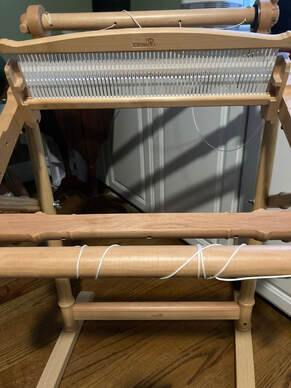
    About 6 years ago, I opened a small rigid heddle loom on Christmas morning.  A friend of mine, with a large floor loom, and I spent a couple of hours putting the loom together and, after she left, I stared at the loom on my kitchen table with some trepidation.  What the heck did I do next?  After a browse through the first chapter of the How-to book, gifted alongside the loom, I decided to try to measure the warp.  

    I didn’t have a warping board or, rather, I did but I didn’t realize the loom itself came with warping pegs and could double as a warping board.  I decided the next best thing was an alternative method described either in the book or found by Googling; I can’t remember which.  I attempted to tie the yarn I was using to a kitchen chair, thread through the heddle, and tie it onto the rod at the edge of the loom.  I don’t remember why I decided that I had measured incorrectly (or maybe I had just tied it on incorrectly and needed to redo it?), but either way I realized that this method was not working for me and I undid it all.  To be fair, having to eat dinner at the table was probably also a reason to pack it all up.  

    It stayed packed up until about two years ago when my husband and I bought a house with enough space to give me a craft room.  It now sits, all set up on its stand, in the corner of my craft room, waiting to be used.  It has waited for two years.  At first it was because I had realized that the loom would double as a warping board and was waiting for the pegs I ordered to arrive.  Then, after I found the pegs that had come with the loom in the first place, it was because I needed to detach the loom from the stand to use the pegs.  Then it was that I hadn’t quite put my craft room together yet (still an ongoing project) and so I didn’t have the space or the time to focus on it.  Finally, I decided to worry about measuring the warp later and just throw a small amount of yarn on the loom and weave something small, maybe 3 inches or so, just to say I had woven something.

    Now, about 6 years after receiving the loom, I have woven nothing, not even something only 3 inches in length.  While procrastination is in my nature, it ramps up more when I’m nervous about something.  In this case, I’m scared to mess up at something new, more than I am being bad at it.  I know those two things seem identical, but being bad means that I am weaving correctly but it doesn’t look pretty or polished at all.  Messing it up means I am weaving incorrectly, that I’m doing it wrong.  

    I’m not sure when I’ll take the plunge, throw some yarn on the loom, gather up my courage, and weave something small.  I’ll let you know when I do though.

  • Author’s Note: This is something I wrote when I was having trouble sleeping for several nights in a row. In my head there’s either a curse on her marriage bed or a blessing on her childhood bed. Either way it’s a fairy tale kind of story idea.


    Princess Soandso wanted it to be known that, despite opinions to the contrary, she had never really gotten all that much sleep.  Yes, she spent an almost inordinate amount of time in bed but a good portion of that had little to do with sleep.  There were cats to pet, sunlight to lounge in, books to be read, and a quiet place where no one was loud or bothersome to enjoy.

    She knew that she had never needed all that much sleep, but this was ridiculous.  No one could survive on the amount of sleep she had been getting and not be yawning during morning council.  Admittedly it was her tenth yawn in the last fifteen minutes but did they really need to look so disapproving?  She was trying to stay awake as best she could but three hours of sleep almost eight hours ago was simply not enough.

    It wasn’t as though she had trouble falling asleep; she just couldn’t stay asleep and couldn’t manage to fall back asleep either.  Her new husband, Prince Notsohelpful, assured her it was from a new bed, a new mattress, and having someone sleep next to her for the first time.  She just had to give herself time to get used to it, he told her.  It wasn’t as though she didn’t know all of that but it wasn’t exactly helpful coming from someone who managed to sleep straight through the night without any perceivable issues.   

    Thankfully he also didn’t seem to have any issues with her sleeping in her old childhood bed, now in the connected would-be nursery.  She knew she had an attachment to the bed, but really it had been her salvation these last few nights.  She really could not have gone another week of not sleeping more

  • Originally Written and Posted: January 21, 2025

    It has been about a year since my most recent, and first ever, post.  A lot has happened and, in the hopes of full transparency, I thought my second post should be an honest update.  Let me explain why I haven’t taught in about 7 months and do not plan on going back to my teaching job until next August, if at all.

    To anyone in the field of education, I do not need to tell you that teaching is stressful and has become politicized in the last several years.  Nor do I intend to spend this post ranting and complaining.  Instead I want to explain why everyone’s platitudes were not enough.

    If you teach, or are in education in general, how often have you heard any of the following: “It’s the same in every district, you know;” “At least it’s not just you;” “The next group of students are different.  We just need to wait it out.;” or “Just take the weekend (or week, or summer) to relax and come back fresh.”  If your experience has been anything like mine, you’ve heard all of these and more. 

    These are not helpful statements and, as I went through the last school year, I found myself countering them in my mind.  Does it matter that it’s every district?  I want it to be different in this district and every district.  I know it’s not just me, but does that mean I need to put up with it?  We say this about the students every year.  We’re never right.  The weekend, vacation week, and/or summer isn’t enough.  

    It got to the point where the platitudes were almost worse than all the other issues and I began to resent them and the implications behind them.  It didn’t feel ok to be miserable all the time just because we were all miserable.  I wanted to be done with the cycle of stress, of constantly feeling tired, of wanting to avoid contact with my colleagues whenever possible (to the point of taking the elevator if I heard someone coming down the stairs) just so I could skip out on everyone else’s negativity.

    Negative and toxic work conditions are not any more unique to my experiences than any of my other complaints about scheduling, student behaviors, meeting schedules, standardized testing pressures, etc.  They were, however, the final nail in the coffin.  I began to realize that I had shut down to the point of no longer being a good teacher.  I hadn’t become a bad teacher, I was just no longer truly teaching.  I felt like I was homework and classwork help instead of teaching, a feeling that was not helped by a curriculum that emphasized independent and group work.

    Finally I realized that while I was physically at work, and doing the bare minimum of my job, my mind and my heart were not.  I agonized over it for months, thinking that every weekend, every vacation week, maybe I would relax and come back refreshed.  After the vacation week in February I had my doubts that I would ever be refreshed enough to be a good teacher again.  I even had a dream where I quit, telling my administrator that I couldn’t keep being this tired all the time.  

    In March I began to come to terms with the idea that I really should take more time since it was clear that a week, and I doubted even the summer, would be enough time for me to really overcome my burnout and my bitterness.  I talked to my union reps and, ultimately, to my supervisor and principal.  Thankfully they both told me to take the time I needed.  My principal told me I would be missed and would always have a place there.  My supervisor told me that she was proud of me for taking what I needed and to focus on me for the year.

    While my thoughts about going back are complicated right now, and not  something that needs to be decided before April, I can say that all my thoughts about needing more time were correct.  It may not have been the right, or financially feasible, move for everyone, but it was exactly the right move for me.   

  • Rural Suburbia: Cross-post

    Written Date: 7 March 2022

    My sister lives in classic suburbia.  Her streets have sidewalks and are arranged, oddly for New England, in a block formation.  My nephews will be able to walk to school once they are old enough to do so.  She and my brother-in-law know their neighbors by name and it is not unusual for my nephews to go across the street to play with the neighborhood children.  My sister lives in classic suburbia, with walks to the town library and a small yard where my nephews play while my sister and brother-in-law are in the house.  They keep a window open to hear if there’s any trouble.  

    The house my fiancé and I have bought does not match up with any of this definition.  The street it is on does not have sidewalks, and we are too far away from the schools for any future children to avoid the school bus system.  Our neighbors are close but not so close that I could casually chat to them from our driveway.  We have about twice as much land, a little over an acre,  than my sister does and there are several acres of unbuildable woodland behind the house.  Unlike my sister’s house, this house has a chicken coop, three rabbit hutches, a small barn and paddock, a greenhouse, a small above-ground pool, and a garden shed.  

    It feels rural, even though I know it’s technically also suburbia and this has caused me to think about the definitions we have of rural and suburban.  Is this small homesteading attempt of mine suburban homesteading?  Or are we too rural for that moniker?  If our neighbors are within 500 feet of us could we even be rural?  I suppose it must be a continuum, a spectrum, of ruralness and suburban-ness.  We are more rural than my sister but more suburban than many others.  This is our rurally suburban homestead.